Refrigerator Repair
How Long a Sub-Zero Fridge Freezer Lasts
A typical refrigerator freezer lasts about 10 to 15 years before a major failure. A built-in Sub-Zero is designed around replaceable parts, so its life depends on which component wears first and whether it is worth fixing. Here is how the cooling system works and what ages it.
Bench notes from
Tobias Reinhardt
- Trade
- Refrigeration technician — doors, gaskets and cabinet fit
- Years on the tools
- 9
- Metro
- Denver
- Holds
- EPA 608 certified
Reading the panel
If the cabinet is showing a code, a lit indicator or a word instead of a temperature, the code and display reference takes it apart reading by reading.
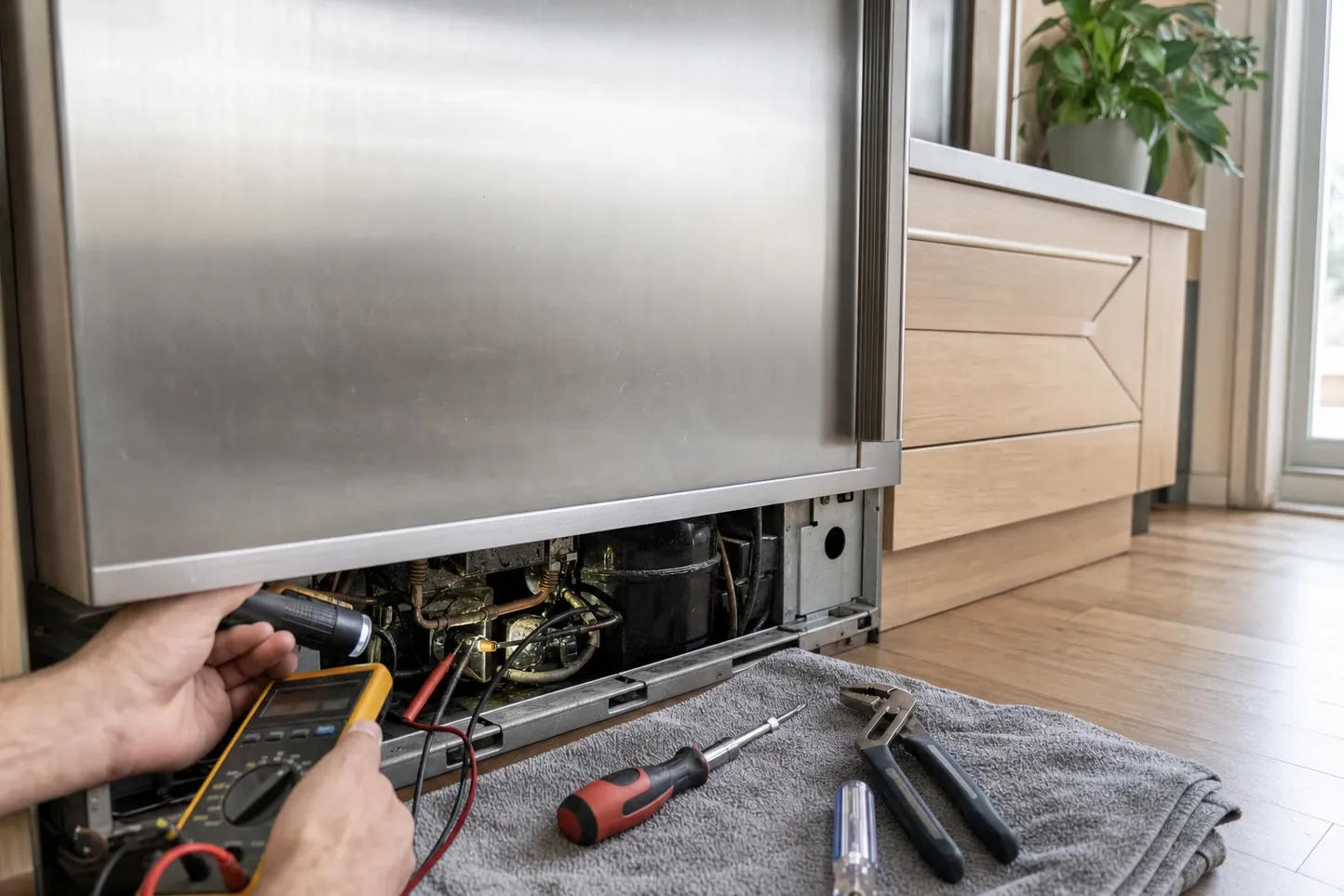
Most refrigerator freezers give 10 to 15 years of service before a major failure makes replacement the sensible call. A built-in Sub-Zero keeps a different clock, because almost every part that wears out can be changed while the cabinet, insulation and custom panels stay where they are. For these units the useful question is not how many years the box survives but which component tires first and whether it is worth replacing. Whether the kitchen sits in a Baker Victorian or a newer house near Sloan’s Lake, understanding how the cooling loop works tells you more than any average.
Why the average is a range, not an expiry date
Lifespan figures blend every kind of refrigerator into one number. A freestanding model with a single cooling loop and tubing foamed into its walls is cheap enough that a dead compressor after a decade usually ends its story. A built-in is engineered and priced the other way around: a comparable new built-in costs several times more than even the largest repair, so fixing the existing unit stays reasonable for much longer. Use matters too. A busy household opening the doors dozens of times a day, a condenser furred with dust, and a unit squeezed beside a hot dishwasher all shorten the life of fans and compressors. Two identical refrigerators can age at very different speeds, and the date on the serial tag is only half the picture.
How a refrigerator freezer makes cold
Every unit runs the same loop. The compressor squeezes refrigerant vapor, which heats it, and the condenser coil and fan shed that heat into your kitchen. The refrigerant then passes a narrow restriction, its pressure drops, and it boils inside the evaporator coil behind the freezer wall, pulling heat from the air the evaporator fan blows across it. Moisture in that air freezes onto the coil, so the control switches on a defrost heater at intervals, and a sensor clipped to the freezer coil reports when the frost has gone. A healthy refrigerator runs in cycles, working much of each hour and then resting. A unit that never stops, a soft freezer or frost creeping over the back wall points to one link in this chain, not to old age.
Two systems, two clocks
Sub-Zero’s name for its layout is Dual Refrigeration. Fresh and frozen food are chilled by independent systems, so leftover smells stay out of the ice and the fresh side keeps its humidity instead of losing it to a frigid coil. Older 200 and 300 Series combinations hide a shortcut in the model number, where every 1 stands for a compressor with its own control. That makes a 361RFD a one-compressor unit and a 3211RFD a two-compressor one, while the 211 is the lone exception that gets by with a single compressor. Where there are two compressors, a tired freezer system does not pull the fresh-food side down with it, which is why a unit where only the freezer side is failing deserves to be priced as a repair first.
How old is yours, really?
The serial tag carries the manufacture date. Over-and-under models from the Classic (BI and CL), 600, 500 and 200/300 Series keep that label high on the inner edge of the refrigerator door, close to the upper hinge. With a side-by-side, open the freezer door instead; with a Classic French-door unit, look on the left door. The 600 Series was built from 1996 to 2009, so any example still running is at least 17 years old; the 500 Series ran from 1987 to 2003, which puts survivors past 23. The BI version of the Classic stayed in production from 2008 until 2022, the year the CL version took over. If old paperwork says Built-In or Integrated, that is the earlier name: in March 2019 those lines became Classic and Designer.
The parts that wear first
Most repairs on an ageing built-in involve a short list of parts. These ranges are typical; the firm price follows diagnosis.
| Part | How it shows its age | Typical range |
|---|---|---|
| Door gasket or seal | Flattened or torn rubber lets room air in | $270–$680 |
| Evaporator or condenser fan motor | Dry bearings squeal, slow down or stop moving air | $310–$680 |
| Defrost heater, thermostat or sensor | Frost thickens on the coil until cold air cannot get through | $280–$690 |
| Electronic control board | Erratic temperatures, a blank display or a stored code | $430–$940 |
| Compressor or sealed-system repair | Warm in every zone it serves | $1,480–$3,420 |
Gaskets and fans are routine. The sealed system decides whether a refrigerator has a future.
Fix it or replace it
For a mainstream fridge past ten years, a sealed-system failure is often the moment to go shopping. A built-in follows different arithmetic: even a compressor job at the top of its band is a fraction of what a new built-in costs. Replacement starts to make sense when the cabinet itself is rusting or cracked, when the sealed system has failed more than once, or when the kitchen is being redesigned anyway. Current Sub-Zero guides warn that these appliances hold flammable refrigerant and that only technicians with flammable-refrigerant training should open the system, so leaks and compressor faults are never a weekend project. Our $89 diagnostic visit traces the actual fault instead of offering a guess, and that fee comes off the repair bill as soon as you approve the work.
Habits that add years at a mile high
Vacuum the condenser grille and coil a few times a year, more often with pets, because a matted coil makes the compressor run hot and long. Wipe the gaskets with mild soapy water and make sure each door closes by itself. Give the unit the power it expects: Classic (CL) refrigerators call for 115 VAC, 60 Hz on a 15 amp dedicated circuit with a grounded 3-prong receptacle, and Sub-Zero advises against a GFCI because it may interrupt operation. In Sub-Zero’s model key the CL3650RA/S/P/L turns out to be a 36-inch Classic all-refrigerator whose glass door is the high-altitude version, worth requesting for a glass-front unit at Denver’s height. To have one looked at in Hilltop, Bonnie Brae or nearby, ring (720) 704-2791 or pick a time with the booking button here.
Follow-ups
Is it worth fixing a 10-year-old refrigerator freezer?
For a built-in Sub-Zero it usually is, because ten years is middle age for an appliance designed around parts that can be swapped. Even the largest repair band, $1,480–$3,420 for compressor or sealed-system work, sits well below what a comparable new built-in would cost. A mainstream freestanding model of the same age is a closer call, especially when the compressor is the part that failed.
How long does a fridge freezer keep food safe without power?
A packed freezer that stays shut keeps food frozen for roughly two days, a half-empty one for about one day, and the fresh-food side for about 4 hours. Keep frozen packages huddled together, and check them with a thermometer before eating or refreezing anything once the lights come back.
How long does a new refrigerator freezer take to get cold?
Expect both compartments to feel cold within a few hours and to settle at their set points over about a day, so stock the shelves gradually. Ice is slower: Sub-Zero says its in-unit ice makers make 64-96 cubes per day, about 8 cubes per harvest every 2-3 hours, and can need 2 days to fill an empty bin.
How do you reset a Sub-Zero freezer?
Switch the unit off at its control or at the circuit breaker, give it several minutes, then restore power so the electronics start fresh. That can clear a confused control, yet it cannot revive a worn fan, heater or sensor. If the same warning or warm reading comes back after the restart, the fault is in hardware and needs a proper diagnosis.