Refrigerator Repair
Why a Sub-Zero Trips the Breaker in an 1890s Baker House: Dedicated Circuits in Denver's Oldest Housing
A Sub-Zero tripping a breaker in Baker or Bonnie Brae is usually a shared circuit rather than a dying compressor: the trip comes at compressor start-up, so the first tests are circuit identification and a voltage reading taken while the unit starts.
Bench notes from
Tobias Reinhardt
- Trade
- Refrigeration technician — doors, gaskets and cabinet fit
- Years on the tools
- 9
- Metro
- Denver
- Holds
- EPA 608 certified
Reading the panel
If the cabinet is showing a code, a lit indicator or a word instead of a temperature, the code and display reference takes it apart reading by reading.
A breaker that drops every few weeks, always without warning, is one of the few refrigeration complaints where the appliance is often innocent. In Denver’s oldest housing it is worth spending twenty minutes on the circuit before anyone spends four figures on the sealed system.
What Denver actually does differently
Much of this city’s inner housing was finished before a kitchen was ever expected to carry several dedicated appliance circuits. The Baker Historic District runs a period of significance from 1873 to 1937 across roughly 150 acres and about thirty blocks. Bonnie Brae grew from a plat begun in 1923. Neither was wired for what sits in those kitchens now.
The designation history — National Register listing in 1985, Denver Landmark District status in 2000 — is worth knowing but does no diagnostic work. What matters is the wiring behind the plaster, and that varies house by house rather than by district boundary. Sloan’s Lake makes the point cleanly: a 1920s bungalow and the scrape-and-build duplex next door sit on the same street with completely different electrical provision, and the duplex almost always has the dedicated run. Hilltop and Bonnie Brae kitchens are a coin toss depending on how thorough the last remodel was.
How that reaches the appliance
A built-in Sub-Zero is specified to sit on its own properly grounded branch circuit. In an un-rewired Baker cottage or a Bonnie Brae brick bungalow, the alcove behind the unit is commonly fed from a general lighting circuit that also serves counter receptacles. Everything works — until two loads coincide.
The coincidence that matters is start-up. A compressor draws heavily for the instant it breaks away from rest, and that inrush is what a shared circuit cannot absorb when something else is already drawing on it. So the breaker does not trip when the unit is idling. It trips when the compartment calls for cooling at the same moment the kettle, the counter appliance or a space heater is running, which is why the pattern looks random from the kitchen and is completely predictable from the panel.
What tends to give first
Three presentations show up, and none of them is a dead compressor. The unit runs faultlessly for weeks and then drops a breaker at start. A shared GFCI device nuisance-trips with nothing obviously wrong. Or the voltage sags far enough during start that the control throws a fault and the display reports a problem that has cleared by the time anyone looks.
The third is the expensive one, because a fault code invites a parts conversation. Owners hear the word compressor and start bracing for the worst number on the price list. Occasionally that is the answer. More often the control has correctly reported that it did not get a clean start, and the reason it did not sits in the wall, not in the cabinet.
There is a second-order cost too. Repeated hard starts on a sagging supply are not kind to the components doing the starting, so a circuit problem left alone long enough eventually becomes an appliance problem as well.
What you can check yourself
Do the observational work, not the electrical work. Write down what else was switched on each time it trips — the specific device, not “something in the kitchen”. Note whether the trip happens at start-up or mid-cycle. Find which breaker actually moved and label it. Plug a lamp into the nearest counter receptacle and see whether it dies at the same time, which tells you the receptacle and the refrigerator alcove share a run.
Two things to avoid. Do not put the unit on an extension lead or a power strip to reach a different outlet. And do not pull the panel cover off. Opening a live panel is a licensed trade’s job in Denver, and the measurement that matters is taken at the appliance anyway.
What a visit settles
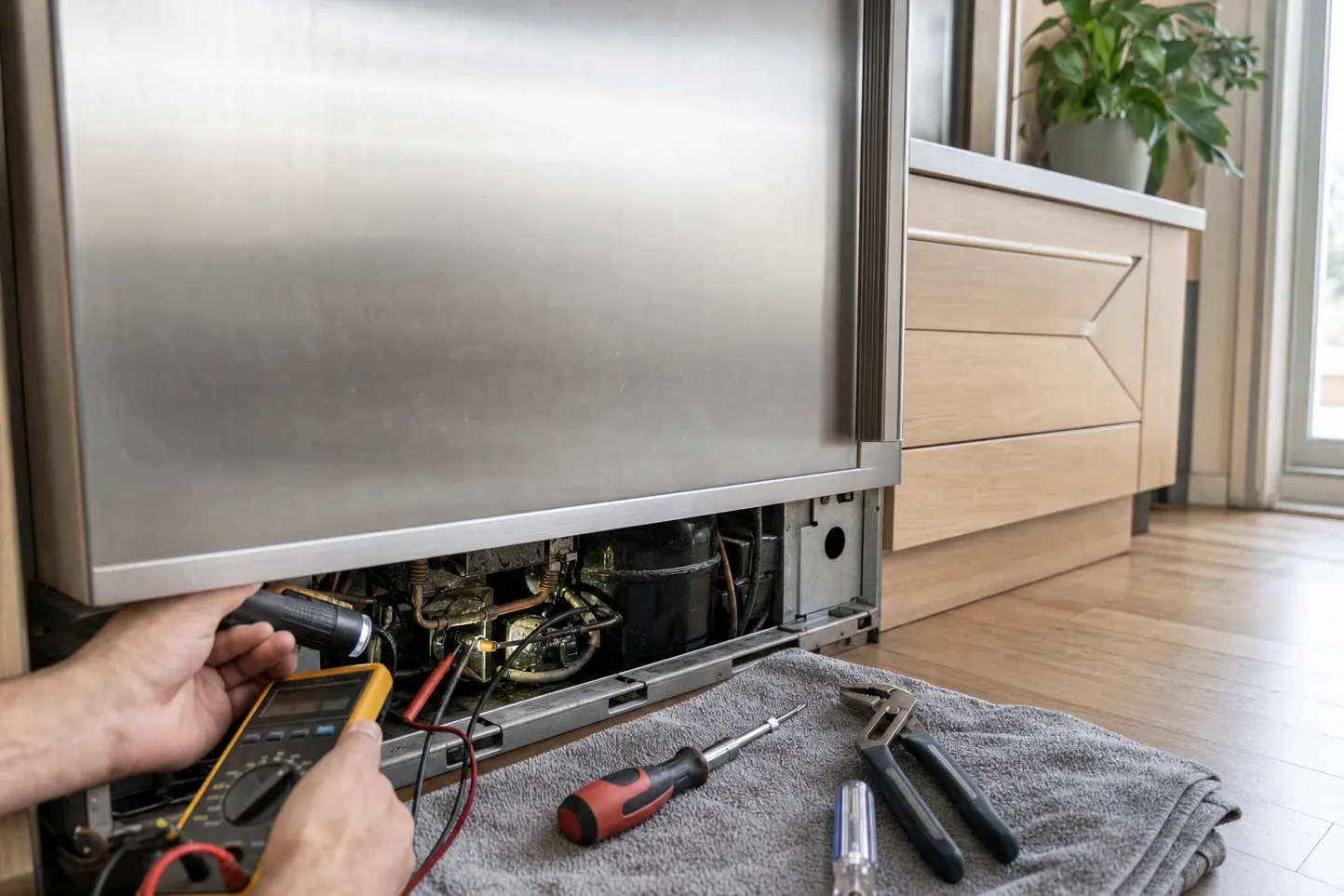
The first tasks on this call are circuit identification and a voltage reading taken while the compressor starts, not while it idles. That pair of measurements separates the two possible worlds. If the supply holds and the current draw is normal, the fault is in the appliance and we work it from there. If the supply collapses during start or the circuit turns out to be shared, the fix is an electrician and a permit — and no part fitted inside the cabinet would have helped.
Knowing which world you are in is what the $89 diagnostic buys. It also answers the other question people in these houses ask, which is whether the kitchen could support an undercounter wine unit or an ice maker at all; the same circuit survey gives you that. If the fault does turn out to be internal, the usual repairs price out as follows: door gasket or seal replacement $270 to $680, evaporator or condenser fan motor $310 to $680, defrost heater, thermostat or sensor $280 to $690, ice maker, water valve or supply line $280 to $790, electronic control board $430 to $940, and compressor or sealed-system work $1,480 to $3,420.
The booking link is above; (720) 704-2791 if it needs a conversation. Mention the trip pattern when you call — start-up versus mid-cycle changes what gets tested first.
Follow-ups
My Sub-Zero only trips the breaker in summer. Is the compressor failing?
Not necessarily. Warm weather makes the compartment call for cooling more often, so there are more start-ups per day, and a start is exactly when a shared circuit is most likely to give up. Seasonality points at circuit capacity at least as strongly as at the compressor, and measuring the supply during a start separates the two.
Can you add a dedicated circuit for the refrigerator while you are here?
No. New branch circuits in Denver are licensed electrical work and normally need a permit and an inspection, which is a different trade from appliance repair. What we can do is identify which circuit the unit sits on, measure what the voltage does at start-up, and give you a written description an electrician can price without re-testing.
Is a power strip or extension lead acceptable behind a built-in?
It should not be used. A built-in is specified for its own properly grounded branch circuit taken from the panel, and cord extensions add resistance precisely where the start-up surge cannot afford any. If the unit cannot reach a suitable outlet, the answer is to have the receptacle relocated rather than to bridge the gap with an accessory.