Ice Maker Repair
Hollow cubes, cloudy ice and an empty bin: Denver water and a Sub-Zero ice maker
Most Sub-Zero ice makers in Denver slow down because of water, not because the module has failed. How clear ice is actually made, what scale and low pressure each look like, and the checks that tell you which one you have before a part gets ordered.
Bench notes from
Tobias Reinhardt
- Trade
- Refrigeration technician — doors, gaskets and cabinet fit
- Years on the tools
- 9
- Metro
- Denver
- Holds
- EPA 608 certified
Reading the panel
If the cabinet is showing a code, a lit indicator or a word instead of a temperature, the code and display reference takes it apart reading by reading.
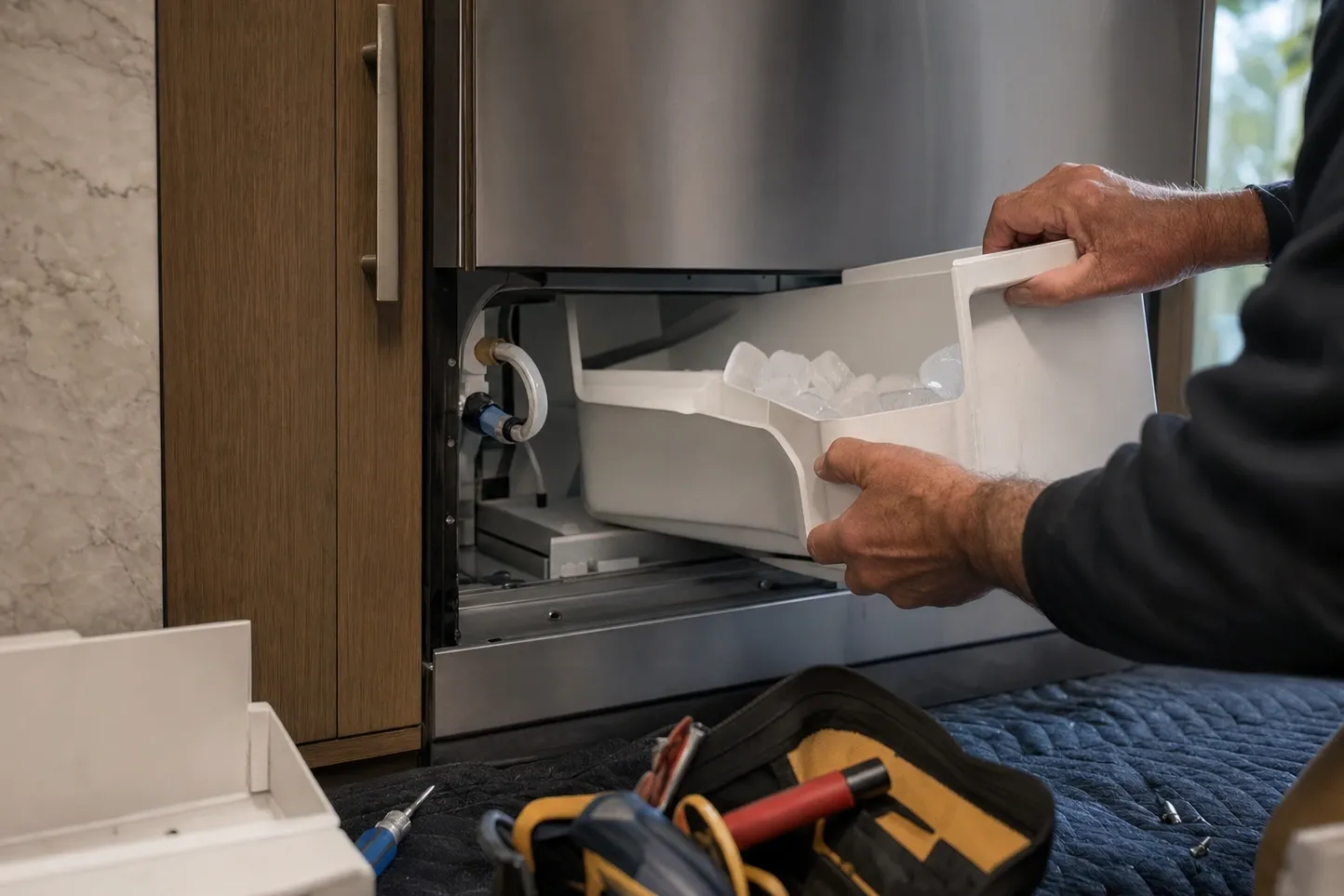
An ice maker that has stopped filling its bin is almost never a dead ice maker. In Denver it is usually water: what is dissolved in it, or how much of it is arriving. Both look identical from the kitchen — small cubes, hollow cubes, cloudy cubes, or a bin that never gets past a third full — and they lead to two completely different repairs.
Understanding which one you have starts with how the ice is made.
How a clear-ice module actually works
A Sub-Zero clear-ice maker does not freeze a tray of water. It runs water continuously over a chilled metal mould, and ice forms in layers from the outside in. Because the water keeps moving, dissolved minerals and air stay in the moving stream instead of being trapped in the cube. That is the whole trick, and it is why the ice comes out optically clear rather than white in the middle.
Two consequences follow from that design, and they are the two failures in this guide.
First, the minerals have to go somewhere. They are left behind on the mould and in the fill tube every single cycle. Second, the process depends on a specific water flow. Too little and the layers never build to full thickness — you get a cube that looks complete from above but is a shell with a hollow centre.
What Denver water does to the mould
Denver water is hard, and around the older housing stock it can be noticeably harder at the tap than the city average suggests. Every cycle deposits a thin film of calcium on the mould surface and inside the fill tube. Over a couple of years that film becomes a crust.
The symptoms in order of appearance:
- cubes release late, or cling to the mould and come out broken
- production drops — the same twenty-four hours yields half the ice
- cubes start coming out cloudy, because the scale disrupts the layered freeze
- the fill tube dribbles instead of running, so water lands on the freezer floor or the mould fills unevenly
- eventually the harvest cycle strains and the module trips out on a fault
The fix is a descale, a fill-tube clean, a filter and a bin scrub — not a module. Once the mould surface is properly clean the same module usually produces normally.
What low water pressure looks like instead
Low flow produces a distinct pattern, and the difference matters because the parts are different.
With scale, the cubes are usually full size but cloudy or fused together, and the mould is visibly crusted. With low flow, the cubes are undersized and hollow but still clear, the mould looks clean, and the shortfall is consistent cycle after cycle.
The usual causes, from most to least common: an inlet valve choked with scale on the strainer, a filter that is years overdue, a saddle valve or shut-off that was never opened fully after a remodel, and a supply line kinked behind the unit when it was pushed back into the cabinet.
That last one is worth checking before anything else if the problem started after any work was done in the kitchen. It costs nothing to look.
What to check before a part gets ordered
Five checks, and only the last needs a tool:
- Look at the mould. Chalky white deposit, or clean metal? That single observation splits the two faults apart.
- Watch a fill. Water should run into the mould as a steady stream for several seconds, not dribble.
- Find the filter and read its age. If nobody knows when it was changed, it is overdue.
- Check the shut-off and the line behind the unit. Fully open, no kinks.
- Measure the flow at the valve. This is where a technician earns the visit — a flow test at the inlet valve says definitively whether enough water is arriving, and it is the test that stops a module being replaced for nothing.
Also check the drain while you are there. A bin sensor gummed with mineral film reports the bin as full when it is not, which stops production with no error at all. And an undercounter unit whose drain pump has failed will put water on the floor of the cabinet before it puts ice in the bin.
When it is worth calling someone out
Call if the mould is crusted, if the fill dribbles, if water is appearing on the freezer floor or under the cabinet, or if production has halved and the filter is not the answer. Those are visits where a descale, a valve, a fill tube or a drain pump ends the problem for years.
Do not order a module on a hunch. It is the most expensive part in the assembly and the least likely thing to have failed. An $89 service call that ends in a descale and a filter is the outcome to hope for here — and in this city, more often than not, that is what it is.
Follow-ups
Is a whole-house softener worth it for the ice maker alone?
For the ice maker alone, no. A dedicated inline filter on the cold feed to the unit, changed on schedule, deals with the scale that reaches the mould for a fraction of the disruption. A softener is a decision about the whole house, and softened water brings its own flavour question for drinking ice.
How long should a clear-ice maker take to fill an empty bin?
A day to a day and a half from empty on a healthy undercounter unit, longer if the room is warm or the bin lid is being opened constantly. Twenty-four hours of production and a bin that is only a third full is a real symptom, not impatience.
Why does the ice smell like whatever is in the freezer?
Because ice absorbs odour, and old ice absorbs a lot of it. If the bin has been sitting at low production the cubes at the bottom have been there for weeks. Dump the bin, wash it, run fresh production and taste that. If the smell comes back, the filter is overdue or the drain is holding water.
Can I just replace the ice maker module and be done with it?
You can, and it is the most common way money gets wasted on this fault. A new module fed by a scaled fill tube or a choked inlet valve produces exactly the same hollow cubes it did before, and now the receipt says the problem is fixed.