Refrigerator Repair
Sub-Zero Refrigerator Codes: Yours to Clear or a Technician's Job
Sub-Zero refrigerator troubleshooting codes sort into three groups: settings you can undo yourself, such as Sh r and double dashes, run-time warnings like EC50 and EC40 that begin with a condenser cleaning, and sensor faults like EE that need a technician.
Bench notes from
Tobias Reinhardt
- Trade
- Refrigeration technician — doors, gaskets and cabinet fit
- Years on the tools
- 9
- Metro
- Denver
- Holds
- EPA 608 certified
Reading the panel
If the cabinet is showing a code, a lit indicator or a word instead of a temperature, the code and display reference takes it apart reading by reading.
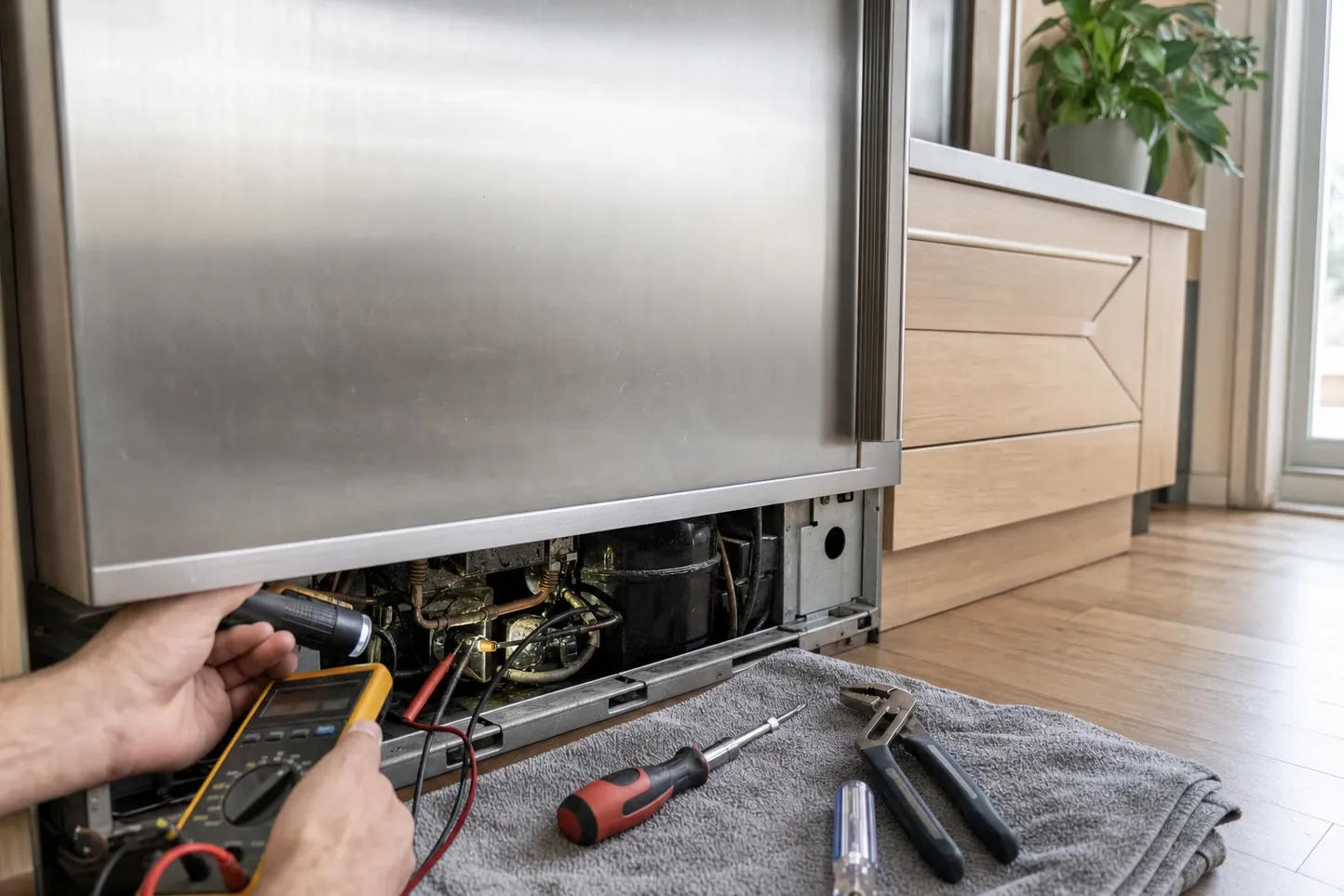
Most Sub-Zero refrigerator troubleshooting codes say one of three things: a setting has been changed, a compressor has run longer than the control expects, or a sensor has stopped reporting. The first kind you undo at the panel in a minute. The second asks for a clean condenser and a thermometer reading before you clear anything. The third, led by EE, is a part failure Sub-Zero gives owners no steps for, so it waits for a technician. Sorting the code first keeps you from silencing a warning that was trying to save the groceries.
Start by identifying the panel
The same fault reads differently on each generation of cabinet, so check the rating plate inside the unit before you search for anything. Older Classic built-ins, the BI line, report trouble with a wrench icon and a chime. On 600 and 700 Series panels the word Service flashes, either between the two zone temperatures or alongside an EC number. Current Classic CL and Designer DET and DEC models use touch controls with plain messages. Key sequences rarely carry over between panels, so our list of Sub-Zero codes and display states is sorted by what appears on the screen.
On a BI, the wrench works like a severity light. Flashing with the chime, it means a major code was logged. Steady with the chime, it marks a minor fault that is not threatening your temperatures: worth booking, not worth panic.
Displays that look broken but are only settings
Several screens worry owners without any part being at fault:
- Sh r on a Classic BI means Showroom Mode, and the unit will not cool while it is on. To leave it, turn the unit off with Power, keep one Warmer key and its Colder partner held, tap Power, and only then lift your fingers from all three.
- Two dashes in a zone on a Classic BI, 600 or 700 Series display mean that zone has been switched off. Press Power to turn the unit off, then hold that zone’s Warmer key while you press Power.
- 38° and 0° that never move on a current Classic or Designer unit that is not cooling can also point to Showroom Mode; Sub-Zero asks owners to phone its customer care line for that one.
- Snooze/Refresh on CL, DET and DEC touch controls is a reminder that the water filter or air purification cartridge is due. Snooze pushes it back 24 hours, and after a fresh filter or cartridge the countdown restarts for about a year.
- Dark interior lights on those same models can mean a door or drawer was left open, because the control cuts the lights to keep their heat out of the cabinet. Shut everything and give it an hour before you call.
Run-time codes: clean the coil, then read the thermometer
These codes count how long a compressor has been working. A dirty condenser is the usual first suspect, and Denver’s dry, dusty air gives a coil plenty to collect, from kitchen lint to pet hair.
- EC50 with Service flashing is long run time on the refrigerator compressor. If the temperatures are close to normal, clean the condenser and hold the bell key, the door ajar alarm, for 15 seconds to clear it. If they are high, book service.
- EC40 on 600, 648PRO and 700 Series units is long run time on the freezer side, a door left ajar, or trouble in the sealed system, a fan or a temperature sensor. Sub-Zero draws the line at 10°: under 10° above the set point, clean the condenser; more than 10° above, with no door left open, schedule a technician. Never clear it while the numbers are still climbing.
- Service flashing between zone temperatures on 600 and 700 Series panels is also excess compressor run. If the readings are close to normal, Sub-Zero’s reset is a cleaned coil followed by 30 seconds with the household breaker switched off.
- Vacuum Condenser flashing means the unit is working inefficiently or running warm, from a dirty coil, a door seal that is not closing, or a fault in the unit itself. Clean the condenser, then switch the refrigerator back on to reset it.
Then clean the condenser and recheck the panel a few hours later.
One ice code sits between the groups. When a lone ice cube icon blinks on a Classic BI without any chime, the fill valve was held open longer than allowed, and the ice maker has been disabled to protect your floor from a flood. Confirm the supply is on and unkinked, then hold Alarm until CFC (Clear Fault Codes) appears.
Codes that belong to a technician
EE with Service flashing on a 600 Series panel, or with the wrench flashing on a BI, is a failed thermistor. Its position names the culprit: on the left it is the freezer sensor, on the right the refrigerator sensor. Sub-Zero publishes no owner fix for it. The same goes for a flashing BI wrench, any EC40 or EC50 with temperatures rising, and a Vacuum Condenser message that returns after a cleaning. A technician can also pull the codes the control has stored, which can show history the live display has already moved past.
Silencing is not repairing: on a Classic BI, holding ALARM and POWER together and releasing both within 5 seconds only hides the fault light for 24 hours.
After a storm or an outage
Summer afternoon thunderstorms along the Front Range can cut power briefly, and a panel may wake up showing a message unrelated to any failed part. Keep the doors closed while you wait; with nothing inside, Sub-Zero expects roughly 3 hours before the freezer climbs above 20°F (-6°C) and the fresh food side above 45°F (7°C). Once power returns, watch whether the temperatures recover before you clear anything.
A quick sorting table
| On the panel | What it usually means | Your first move |
|---|---|---|
| Sh r | Showroom Mode, no cooling | Run the exit sequence |
| Two dashes in a zone | That zone is switched off | Warmer key plus Power |
| EC50 or EC40, temperatures near normal | Long compressor run | Clean the condenser, then clear |
| EC40, more than 10° above set | Sealed system, fan or sensor | Book service |
| EE | Failed thermistor | Book service |
| Flashing wrench on a BI | Major code logged | Book service |
What a visit costs
Our $89 service call is a full diagnosis rather than a glance at the display, and that fee comes off the repair bill as soon as you approve the work. Typical ranges for the repairs these codes lead to: a defrost heater, thermostat or sensor runs $280–$690, an evaporator or condenser fan motor $310–$680, an electronic control board $430–$940, and compressor or sealed-system work $1,480–$3,420. You get a firm quote once the diagnosis is done. Call (720) 704-2791 from Sloan’s Lake, Baker, Hilltop or Bonnie Brae.
Follow-ups
Why is my Sub-Zero refrigerator not cooling when the display shows no error code?
A warm unit with a quiet display is often in Showroom Mode or has a zone switched off. Look for Sh r on a Classic BI panel, two dashes in one zone, or a fixed 38° and 0° on newer Classic and Designer controls. If none of those apply, the fault may be one the control does not log, and it needs to be measured.
Can I clear a Sub-Zero code by turning the breaker off?
Only for the flashing Service message on 600 and 700 Series panels, and only once the condenser is clean and the temperatures are close to normal; Sub-Zero's step is 30 seconds with the breaker off. Cutting power to wipe an EE or a climbing EC40 just hides the warning while the problem carries on.
What's the difference between a Sub-Zero and a regular fridge when a code appears?
Most Sub-Zero built-ins cool the fresh food and freezer sections separately and report on each one, which is why EC50 refers to the refrigerator compressor and EC40 to the freezer. A basic top-freezer fridge usually has one cooling system and little or nothing on a display to read, so it simply runs warm without telling you why.
How long can food wait if my Sub-Zero stops cooling?
Sub-Zero's figure is about 3 hours for an empty unit: by then the freezer has typically warmed past 20°F (-6°C) and the fresh food side past 45°F (7°C), so keep the doors shut while you sort out the code. A well-stocked freezer generally holds its cold longer, but every door opening to check shortens the window.
Does silencing the alarm on a Classic Sub-Zero fix the fault?
No, silencing only hides the fault indicator for 24 hours. On a Classic BI you hold ALARM and POWER together and let go of both within 5 seconds, which buys a quiet night, but the malfunction is still there and the chime returns if nobody repairs it.